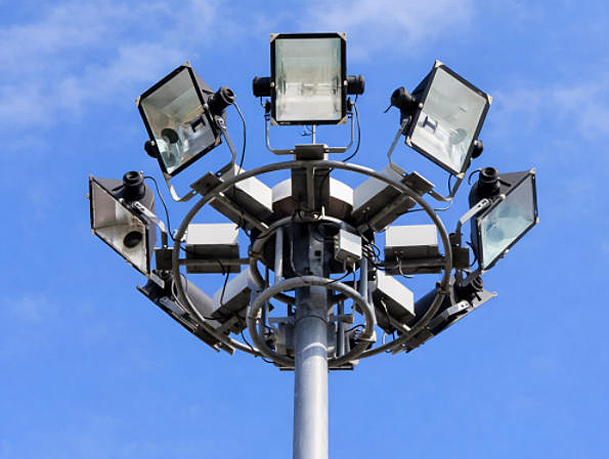


Quick answer: select high mast height from a lighting calculation, obstruction study, spill-light limits, structural conditions and maintenance strategy. A taller mast can cover a wider area, but it also changes floodlight optics, glare, wind loading, foundation reactions, access requirements and project cost. There is no universal rule that a 40m mast is better than a 30m mast.
| Nominal height | Common project context | Key design focus |
|---|---|---|
| 30m | Interchanges, yards, large parking, industrial sites and venue surroundings. | Coverage from practical pole spacing, glare control and ground-level maintenance. |
| 40m | Ports, container terminals, large logistics aprons and major area-lighting projects. | Longer throws, equipment EPA, coastal corrosion and heavy-duty lowering system. |
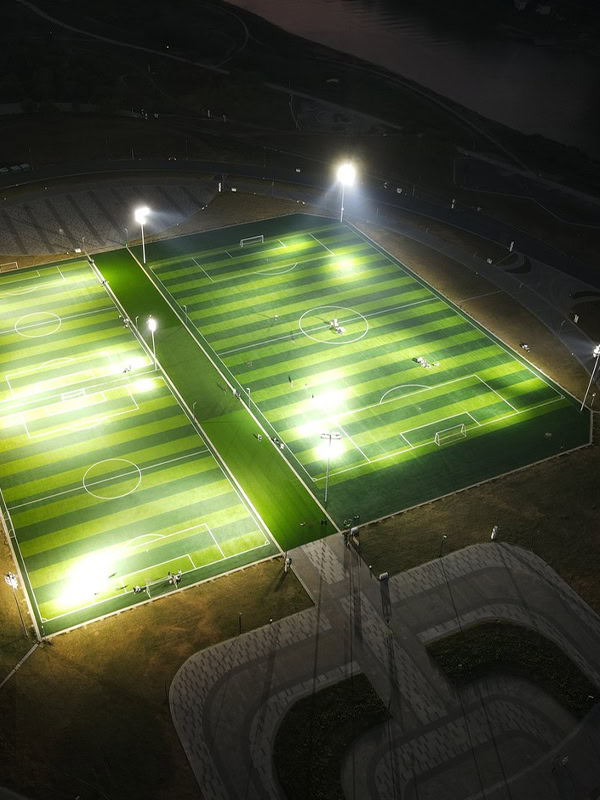
| 45m | Large stadium or arena floodlighting and very wide unobstructed areas. | Vertical illuminance, aiming, broadcast or competition criteria, access and structural dynamics. |
This table is a starting point, not a final specification. A 30m solution with more locations may outperform a smaller number of 45m masts when glare, shadows, obstructions or spill-light boundaries govern the project.
The calculation should use project-specific photometric files, realistic mounting positions and approved aiming limits. It should report average, minimum and maximum illuminance where required, uniformity, grid definition, power and relevant glare or spill-light metrics. For sports projects, horizontal illuminance alone may be insufficient; vertical planes and camera directions may be needed.
A taller mast may reduce the number of pole locations, yet require narrower or higher-output optics to deliver light over longer distances. This can increase fixture quantity, installed power or glare if the layout is not optimized. It also increases erection and maintenance constraints. The best design compares complete alternatives, including civil works and lifetime service access.
There is no fixed area. Coverage depends on height, luminaire photometry, aiming, target lux, uniformity, obstructions and spill-light limits.
No. Venue dimensions, competition level, roof and seating geometry, camera requirements and local restrictions determine the suitable arrangement.
Yes, when modelling shows that different zones benefit from different heights. The drawings and calculations should clearly identify each mast type and equipment schedule.
After the lighting concept and site constraints are reviewed, but before final structural, foundation and procurement documents are issued.
Compare detailed Jieyao configurations for 30m high mast lighting, 40m high mast lighting and 45m stadium high mast lighting.
Contact Us
Get a custom lighting solution and quotation for your project. Outdoor lighting manufacturer in Yangzhou, ChinaAbout Jieyao LightingYangzhou Jieyao Lighting Equipment Co., Ltd. is an outdoor lighting manufacturer focused on solar street light systems and high mas... Do you have any questions or requests?
Email: jay@jieyaolighting.com

Click to Chat.
Im online now.