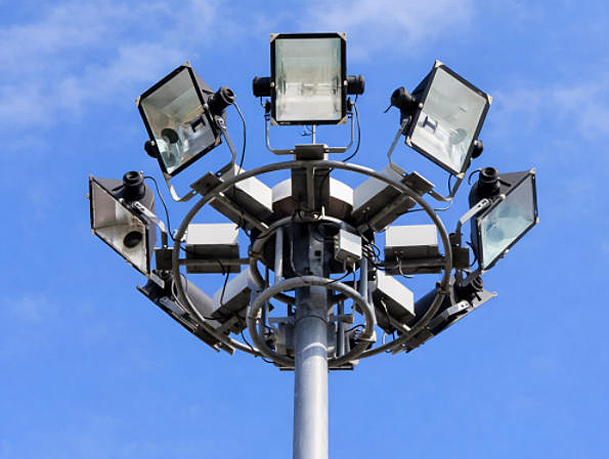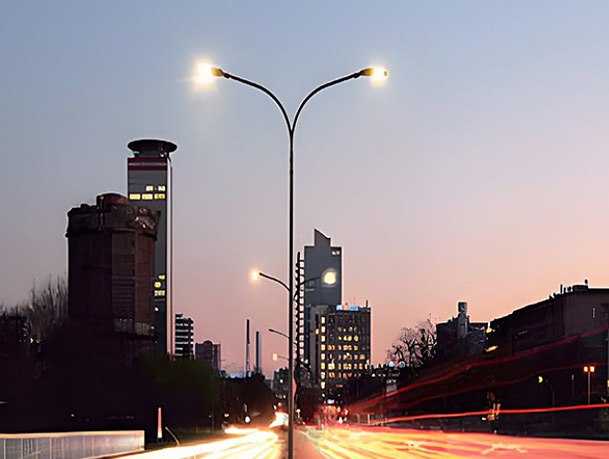


What is high mast light ?A high mast light is a high-performance outdoor lighting solution engineered to illuminate expansive areas from heights ranging from 12 meters to 50 meters. Unlike standard street lighting, a high mast system integrates a tall steel pole with a multi-luminaire head, providing broad and uniform light distribution with minimal installation points.For buyers, contractors, and project engineers, high mast light focuses on more than just elevation. The core value lies in coverage efficiency, reduced maintenance overhead, and consistent performance for large-scale infrastructure projects. |
Optimized Core Components Breakdown Every professional high mast lighting system integrates four essential assemblies: ▶ Tapered Steel Pole: Engineered from multi-section, hot-dip galvanized Q345 or Q235 steel. These sections utilize a slip-fit design with a decreasing diameter profile. Available cross-sections include octagonal, dodecagonal (12-sided), and hexadecagonal (16-sided) geometries for maximum structural rigidity. ▶ Luminaire Ring and Carriage: A robust circular steel frame designed to support 4 to 16 LED floodlight fixtures. This carriage remains at the pole head during operation and allows for precision adjustment of mounting angles for each individual light module. ▶ Raising and Lowering Mechanism: A specialized motorized winch system equipped with stainless steel cables. This device brings the luminaire ring to ground level, facilitating safe maintenance without the high costs of crane trucks or bucket lifts. ▶ Foundation and Anchorage: A reinforced concrete base utilizing J-bolt or L-bolt anchor assemblies. Each system is custom-engineered to withstand specific soil conditions and site-specific wind load requirements. |
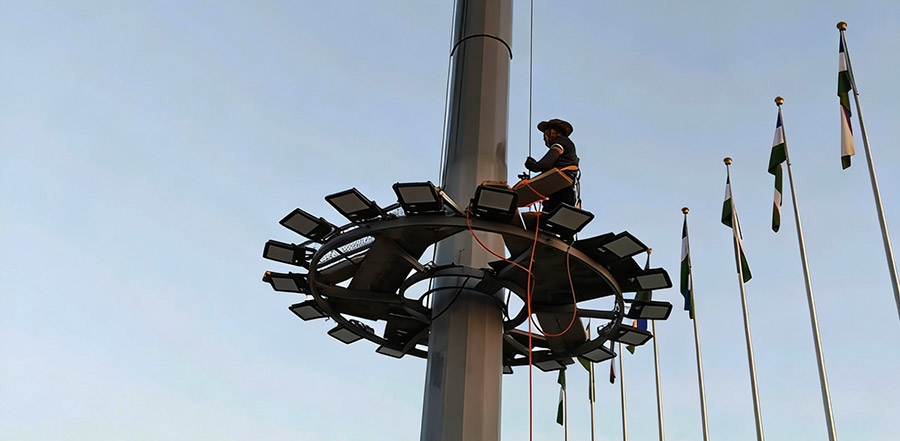
Specifying a high mast pole light correctly requires understanding three categories of specifications: the pole structure, the LED fixtures, and the illumination requirements for your application.
Pole Specifications |
Parameter | Specification Range |
Height | 15-55m (common: 20, 25, 30, 35, 40m) |
Material | Q235B or Q345B structural steel |
Wall thickness | 4-12mm (base section thicker) |
Cross-section | Octagonal, dodecagonal, or hexadecagonal |
Sections | 2-4 tapered sections, slip-fit joints |
Surface treatment | Hot-dip galvanizing (65-85 microns) + polyester powder coat |
Top diameter | 180-380mm (varies with height) |
Base diameter | 400-1200mm (varies with height) |
Wind speed rating | Up to 55 m/s (per ASCE 7 or EN 40) |
The surface treatment remains a decisive factor for structural longevity. Adhering to ASTM A123 or ISO 1461 standards, our hot-dip galvanizing process ensures 25 to 30 years of robust corrosion protection. Jieyao Lighting applies a minimum 86-micron zinc coating (exceeding standard requirements) to all high mast poles, with each section verified via magnetic thickness gauges at three strategic points to guarantee uniform coverage.
LED Fixture Specifications |
Parameter | Range |
Power per fixture | 200-2,000W (LED) |
Fixtures per ring | 4-16 |
Light efficacy | 120-160 lm/W |
Color temperature | 4000K-5700K |
CRI (Color Rendering) | >70 (Ra) |
Protection rating | IP66 minimum |
Surge protection | 10-20 kA SPD |
Operating life | >50,000 hours (L70) |
Beam angle | 15-60 degrees (adjustable) |
Illumination Standards |
Application | Average Lux | Uniformity (Uo) | Standard |
Highway interchange | 15-25 lux | ≥0.3 | IES RP-8 / EN 13201 |
Airport apron | 20-30 lux | ≥0.25 | ICAO Annex 14 |
Container port/yard | 30-50 lux | ≥0.4 | CIE 169 |
Stadium/sports field | 300-500 lux | ≥0.5 | EN 12193 |
Large parking lot | 10-20 lux | ≥0.25 | IES RP-20 |
Industrial zone | 20-30 lux | ≥0.3 | EN 12464-2 |
Mounting Configurations ▶ Fixed Crown Design: Luminaires remain permanently secured at the pole head. Access for maintenance necessitates the use of a bucket truck or professional crane. While offering the lowest initial investment, it incurs the highest long-term operational costs. This option is recommended only for sites where heavy machinery access is permanently assured. ▶ Raising and Lowering System: A motorized internal winch descends the luminaire carriage to 1.5 meters above ground level for technician access. As the global industry standard, this configuration accounts for over 80 percent of high mast installations due to its superior safety and cost-efficiency. ▶ Mid-Hinge or Tilt-Down Type: The structural pole itself pivots to a horizontal orientation for service. This design is restricted to shorter elevations (typically under 20 meters) and is engineered for lighter luminaire payloads to ensure mechanical stability. |
High Mast Lighting Application Scenarios (customized high mast lighting system) | |
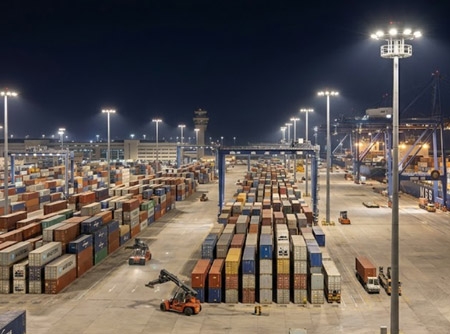
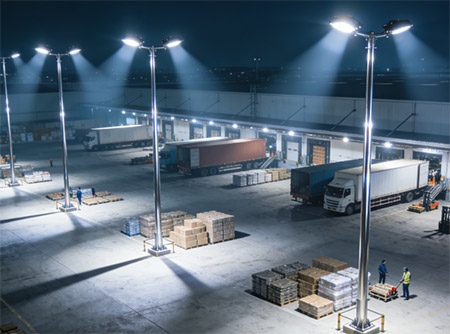
| Seaports: For busy container terminals, port high mast lighting ensures safe navigation for ground crews and vehicle operators. These systems provide broad light coverage that helps eliminate dark spots among stacked containers, allowing for smooth loading and unloading operations throughout the night. |
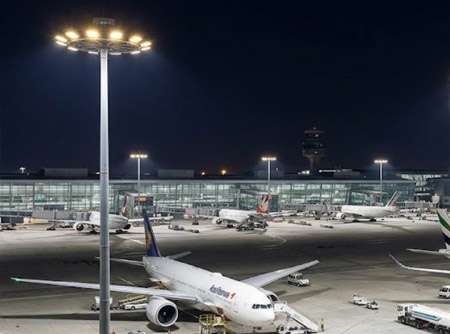
| Airports: In large aviation hubs, airport apron lighting is essential for ground handling and refueling tasks. The focus is on providing high visibility across expansive runways and docking areas, ensuring that ground staff can perform their duties with precision while maintaining clear sightlines for incoming aircraft. |
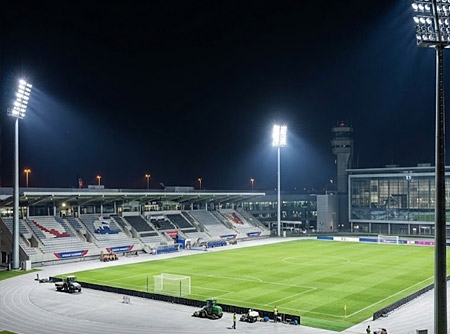
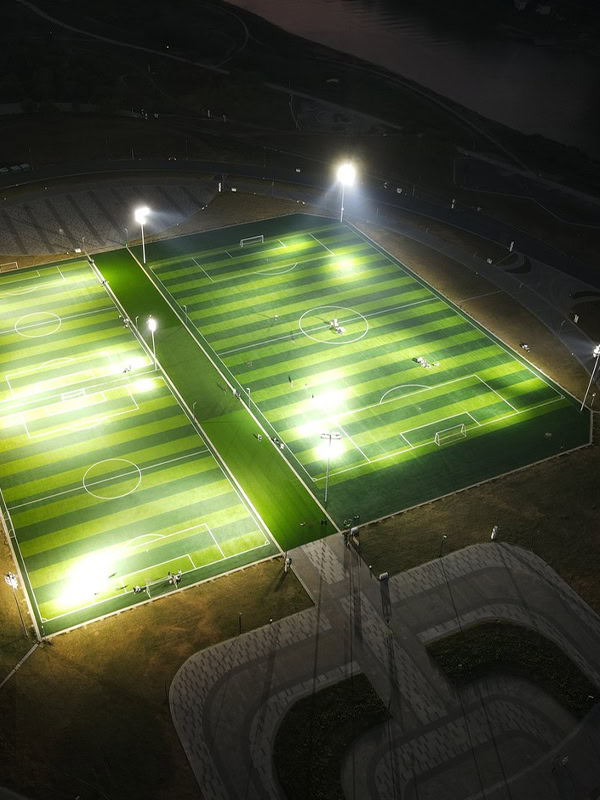
| Sports Venues: For outdoor athletic fields and arenas, stadium high mast lighting delivers the brightness required for clear visibility. This setup ensures that the entire playing surface is evenly lit, providing a comfortable environment for both players and spectators without the need for many scattered light poles. |
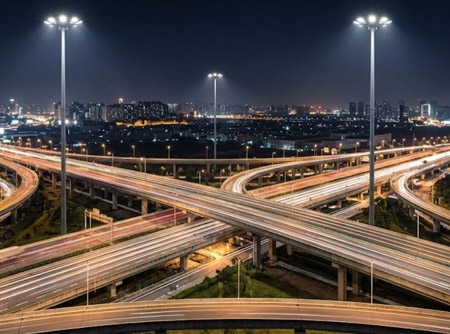
| Highways: At complex road junctions and toll areas, highway high mast lighting improves driver safety by illuminating large sections of the road from a single point. This reduces visual confusion and helps drivers clearly see merging lanes and exit signs from a distance, even during heavy rain or fog. |
| Logistics Centers: For massive storage yards and distribution hubs, industrial yard lighting supports constant truck movement and cargo sorting. Using poles with lowering systems allows facility managers to handle maintenance at ground level, keeping the work zones bright and productive without blocking traffic with ladders. |
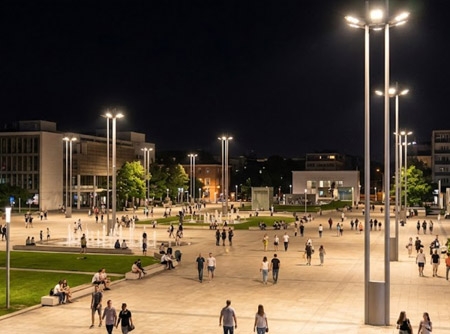
| Public Plazas: In large city squares and commercial parking lots, area high mast lighting enhances public security and comfort. A single tall pole can light up an entire square, creating a safe atmosphere for pedestrians and reducing the complexity of underground wiring needed for multiple smaller poles. |
Foundation Design and Wind Load Essentials |
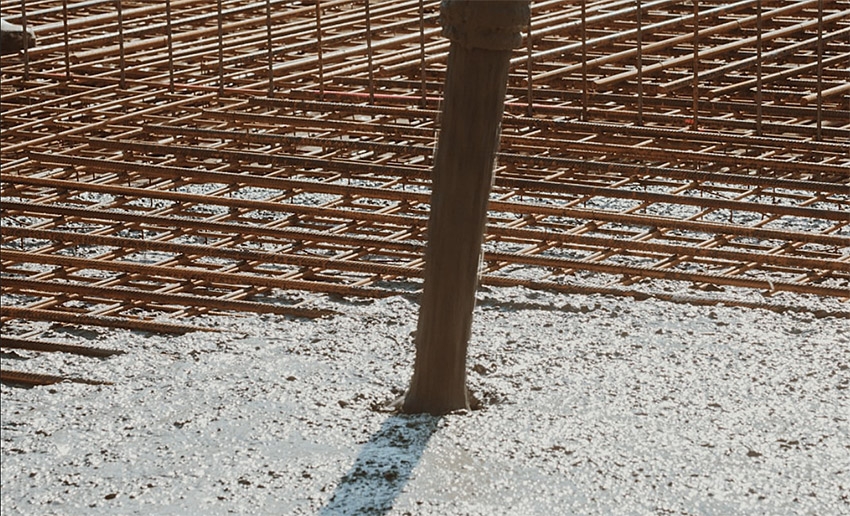
Concrete foundation with anchor bolts for high mast pole installation
Foundation Types |
Foundation Type | Soil Condition | Pole Height | Notes |
Reinforced concrete pad | Normal bearing capacity (≥150 kPa) | 15-40m | Most common type |
Pile foundation | Soft/unstable soil (<100 kPa) | All heights | Required in marshland, reclaimed land |
Rock anchor | Bedrock near surface | All heights | Drilled anchors into rock |
Rule of thumb: Foundation depth should be approximately 1/6 of the pole height. A 30-meter pole typically requires a foundation 4.5-5 meters deep with a concrete volume of 8-12 cubic meters.
Wind Load Calculation Wind load is the primary structural design driver for every high mast pole light. The key inputs: ▶ Design wind speed: Based on local building code (50-year return period) ▶ Pole EPA: Effective Projected Area, including the pole shaft and all fixtures ▶ Drag coefficient: 0.85-1.0 for round/tapered poles; 1.0-1.2 for polygonal sections ▶ Safety factor: Typically 1.5x applied to the design wind speed JIEYAO Pole performs full wind load analysis per ASCE 7 (US), EN 40 (EU), or local national codes. Every pole design includes a signed structural calculation package. See our wind load and structural strength testing methodology for details.
Installation Sequence ▶ Excavation and reinforcement cage placement ▶ Concrete pour (minimum 28-day cure before pole erection) ▶ Base section erection onto anchor bolts (torque to specification) ▶ Upper section assembly (slip-fit, bolted joints) ▶ Luminaire ring assembly and electrical connection at ground level ▶ Raising test (lower and raise the ring 3 full cycles) ▶ Final electrical commissioning and tilt alignment verification |
the performance and maintenance differences between HPS and LED systems |
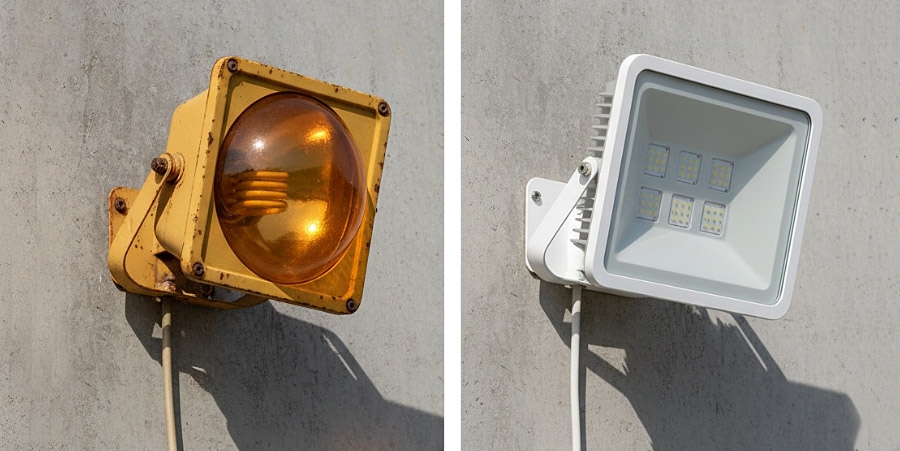
Parameter | HPS High Mast System | LED High Mast System | Note for 2026 Procurement |
System Efficacy | 60 to 80 lumens per watt | 140 to 180+ lumens per watt | LED provides significantly more light for less energy. |
Rated Lifespan (L70) | 15,000 to 24,000 hours | 50,000 to 100,000+ hours | LED modules require far fewer replacements, reducing high-risk maintenance. |
Color Rendering (CRI) | 20 to 30 (Very Poor) | 70 to 90+ (Excellent) | Poor CRI makes it difficult to distinguish colors in logistics yards. |
Color Temperature (CCT) | 2000K to 2200K (Warm Yellow) | 3000K to 6500K (Customizable) | Cool white (5000K+) improves operator alertness and security. |
Optical Utilization | 40 to 60 percent (Wasted Light) | 80 to 95+ percent (Precise Focus) | LED optics put light exactly where needed, reducing light pollution. |
Maintenance Need | High (Bulb/Ballast Failure) | Very Low (Long Driver Life) | High mast maintenance requires high-risk, expensive equipment. |
Instant On/Off | No (3 to 10 minute warm-up) | Yes (Instantaneous) | Critical for security or after a power outage. |
Dimming Capability | Extremely limited or expensive | Standard with 1 to 10V or DALI | Allows significant additional energy savings after active hours. |
High Mast Lighting Frequently Asked Questions
1. What is the standard height for a high mast light pole? Most high mast light poles range from 15 meters to 45 meters. The exact height depends on the total area you need to illuminate. For example, a 30 meter pole is the most common choice for large logistics yards and highway interchanges to ensure broad light coverage.
2. How do LED high mast lights save money compared to older lamps? Modern LED high mast systems use about 50 percent to 70 percent less electricity than traditional sodium lamps. Because LED modules last over 50,000 hours, you also save thousands of dollars on maintenance and crane rentals by avoiding frequent bulb replacements.
3. Is a lifting system necessary for every high mast pole? While not mandatory, a raising and lowering system is highly recommended for poles over 20 meters. It allows your team to bring the lights down to ground level for service. This keeps workers safe and eliminates the high cost of hiring a cherry picker or crane every time a light needs cleaning.
4. How do high mast poles withstand strong winds and storms? Every steel high mast pole is engineered based on local wind load requirements. We use high-strength steel and a tapered design to ensure the structure remains stable. For coastal areas, we provide specialized calculations to ensure the pole can survive hurricane-force winds.
5. What is the best surface treatment to prevent rust? Hot-dip galvanizing is the industry standard for long-term protection. By dipping the steel into molten zinc, the pole gets a thick coating that prevents rust for 25 to 30 years, even in salty or humid environments near ports.
6. Can I upgrade my old high mast lights to LED without replacing the pole? Yes, this is called an LED retrofit. If your existing steel pole is structurally sound, you can simply replace the old headframe with a new LED luminaire ring. This is a cost-effective way to improve brightness and save energy immediately.
7. How many LED fixtures do I need on a single high mast pole? The number of fixtures typically ranges from 4 to 16 per pole. It depends on the brightness levels required for your specific site. A Dialux lighting simulation can help determine the exact quantity and angle to avoid dark spots.
8. What is the difference between Q235 and Q345 steel? Q345 is a high-strength steel often used for taller or more heavy-duty poles. It can handle more stress than Q235. Choosing the right material ensures your high mast lighting system stays upright and safe for decades.
9. How do you maintain the cables in a lifting high mast system? We use high-quality stainless steel cables that are resistant to weather and tension. During routine checks, technicians should inspect the cables for any fraying. The automatic locking mechanism at the top also takes the weight off the cables when the lights are in place, extending their life.
10. Do high mast lights cause glare for neighbors or drivers? Professional industrial lighting uses specialized lenses to direct light downward and inward. This "cutoff" design ensures the light stays on your property and doesn't spill into the sky or blind drivers on nearby roads.
11. How long does it take to install a high mast lighting system? Once the concrete foundation is cured, the actual assembly and standing of a slip-fit high mast pole usually takes one to two days. This includes assembling the sections, installing the wiring, and testing the lifting motor.
12. What information do I need to provide for an accurate quote? To get the best price and design, you should provide the pole height, the number of lights, your local wind speed, and the type of area you are lighting. With these details, Jieyao Lighting can create a custom solution that fits your budget and safety needs. |
Ready to discuss your high mast pole light project? |
Contact Us
Get a custom lighting solution and quotation for your project. Outdoor lighting manufacturer in Yangzhou, ChinaAbout Jieyao LightingYangzhou Jieyao Lighting Equipment Co., Ltd. is an outdoor lighting manufacturer focused on solar street light systems and high mas... Do you have any questions or requests?
Email: jay@jieyaolighting.com

Click to Chat.
Im online now.