

An export packing plan for street light poles should preserve the approved pole geometry and finish, keep every loose component traceable to its pole mark, and let the receiving team unload without guesswork.
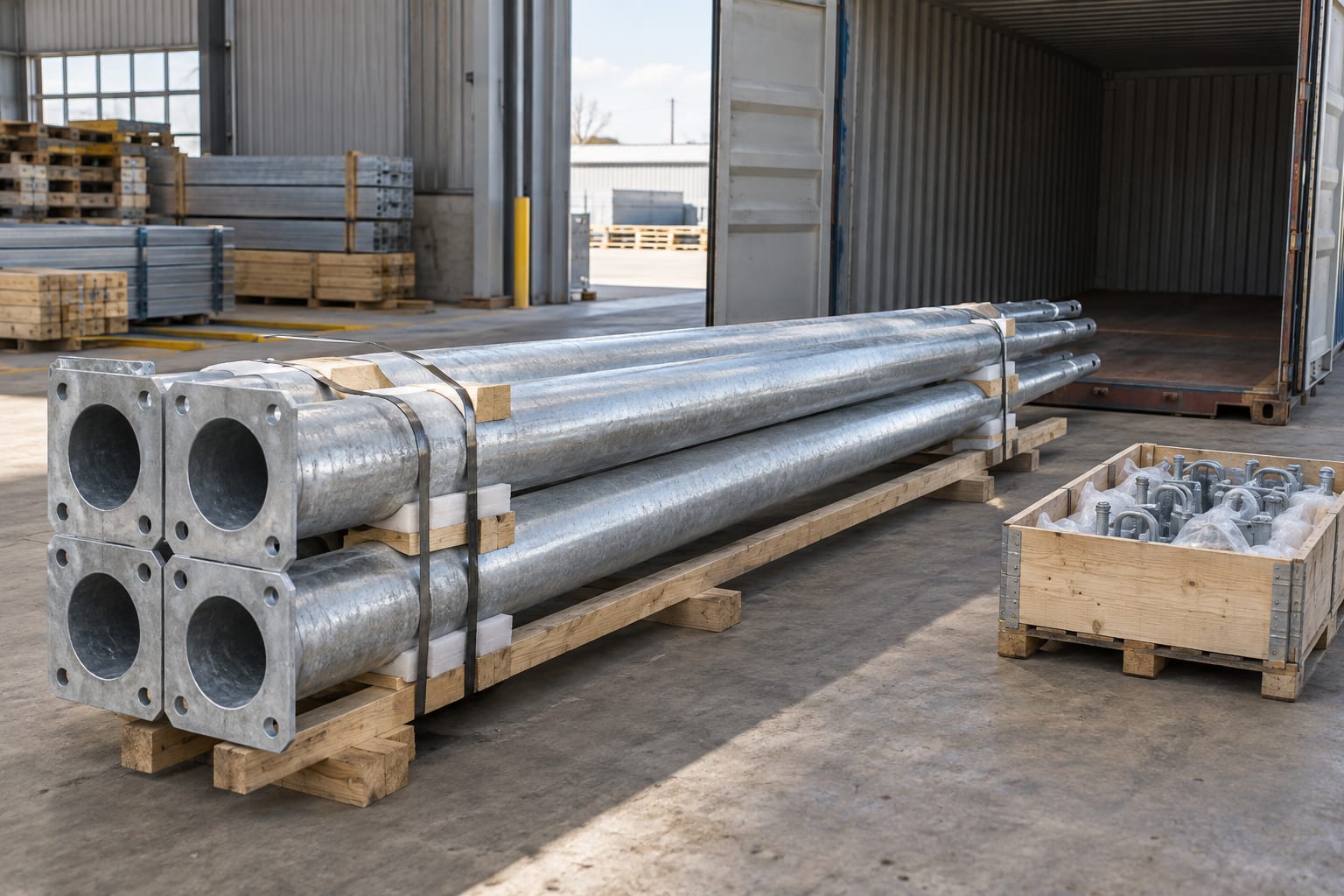
Separated pole sections and marked accessory crates support controlled container loading.
A long shaft may be fabricated correctly yet arrive with a bent projection, abraded coating or an orphaned arm. Packing is therefore a controlled handover step, not a final decorative wrap.
Start with the actual shipping set: lengths, maximum section mass, pole profile, base-plate projection, arm shape, coating system, loose hardware, anchor sets and container or truck limits. The supplier and freight forwarder should agree lifting points, dunnage positions and load-securing details for the specific cargo. This guide is a purchaser's review checklist; the responsible shipping team must design the final load restraint and follow the carrier's rules.
The approved drawing and packing list should use the same pole marks and revision numbers. Record whether each pole ships as a one-piece shaft, a splice assembly, or multiple sections, and whether arms and brackets are detached. Do not assume that nesting tapered shafts is acceptable: the coating, geometry and contract packing method determine whether contact can be controlled. List the parts that cannot be loosely placed inside a shaft, such as doors, wiring accessories or labelled fasteners.
For a flanged-base pole, protect plate edges and avoid loading the entire base plate against another shaft. For a direct-burial pole, protect the buried-end identification and any transition detail. For a pole with an access door, ensure the door and fasteners remain associated with the correct body, and that packaging does not press against the opening. The street light pole product hub shows configuration families; the particular purchase drawing controls packing dimensions.
This matrix maps physical features to packaging controls. It does not prescribe one universal number of supports, strap tensions or container capacity; those depend on the actual load and transport plan.
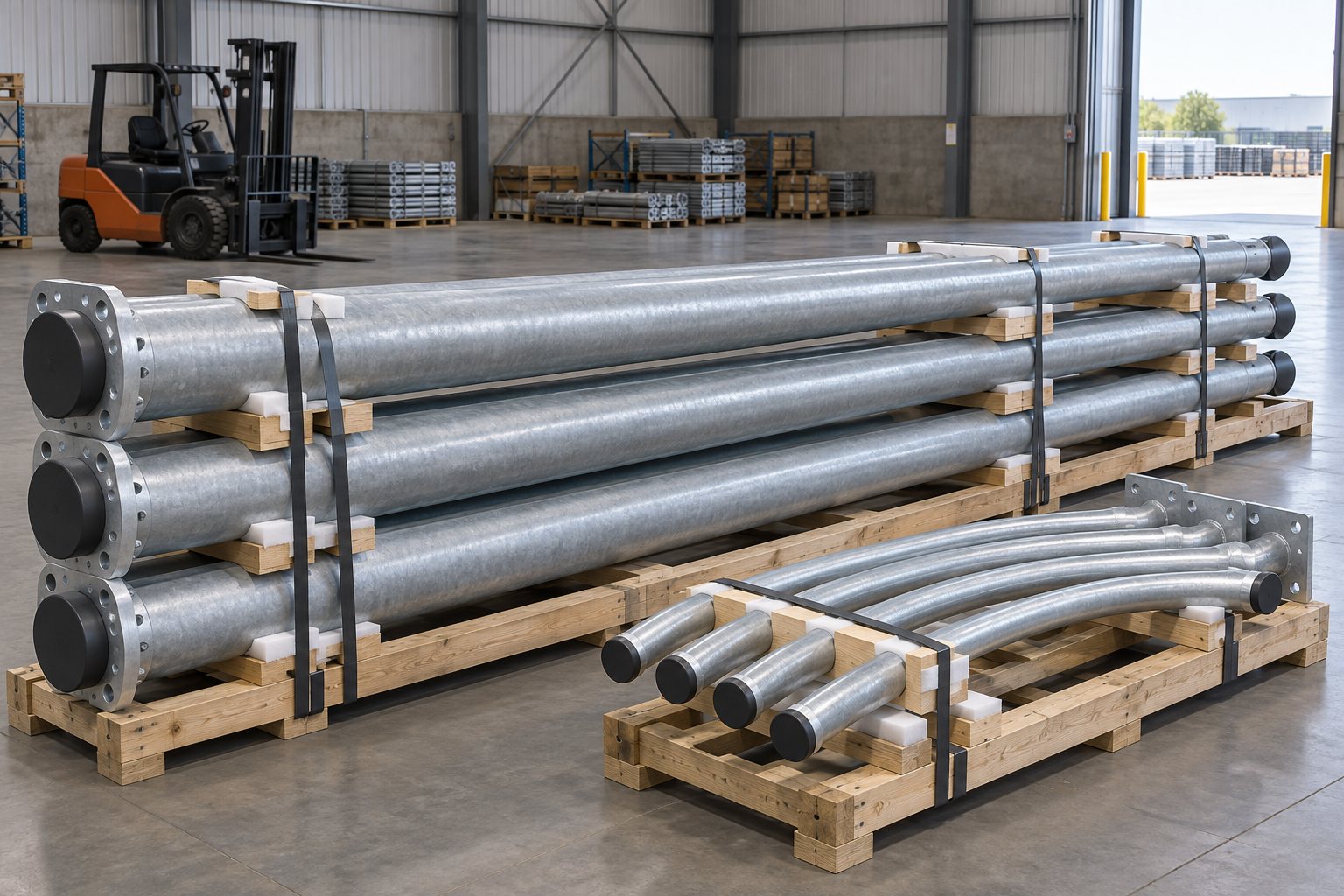
Separators and support points help reduce rubbing at steel and coating interfaces.
Inspect and record the finish before wrapping. Put separators between steel surfaces, and keep abrasive grit out of contact areas. Use pads beneath bands or straps so securing force is not concentrated at a sharp edge. Packaging materials must be compatible with the specified coating and expected transit conditions; the coating supplier's instructions govern any special moisture or contact restriction.
Protect access openings and cable entries against dirt and impact, but avoid covering identification that the receiving team needs to verify. Where a pole has a painted topcoat, allow the specified cure before packing. If a finish defect is discovered before loading, document and resolve it under the contract's repair procedure rather than relying on wrapping to conceal it. The earlier shop-drawing approval checklist is a drawing-stage resource, not proof of packing release; use the actual signed FAT report for the shipment.
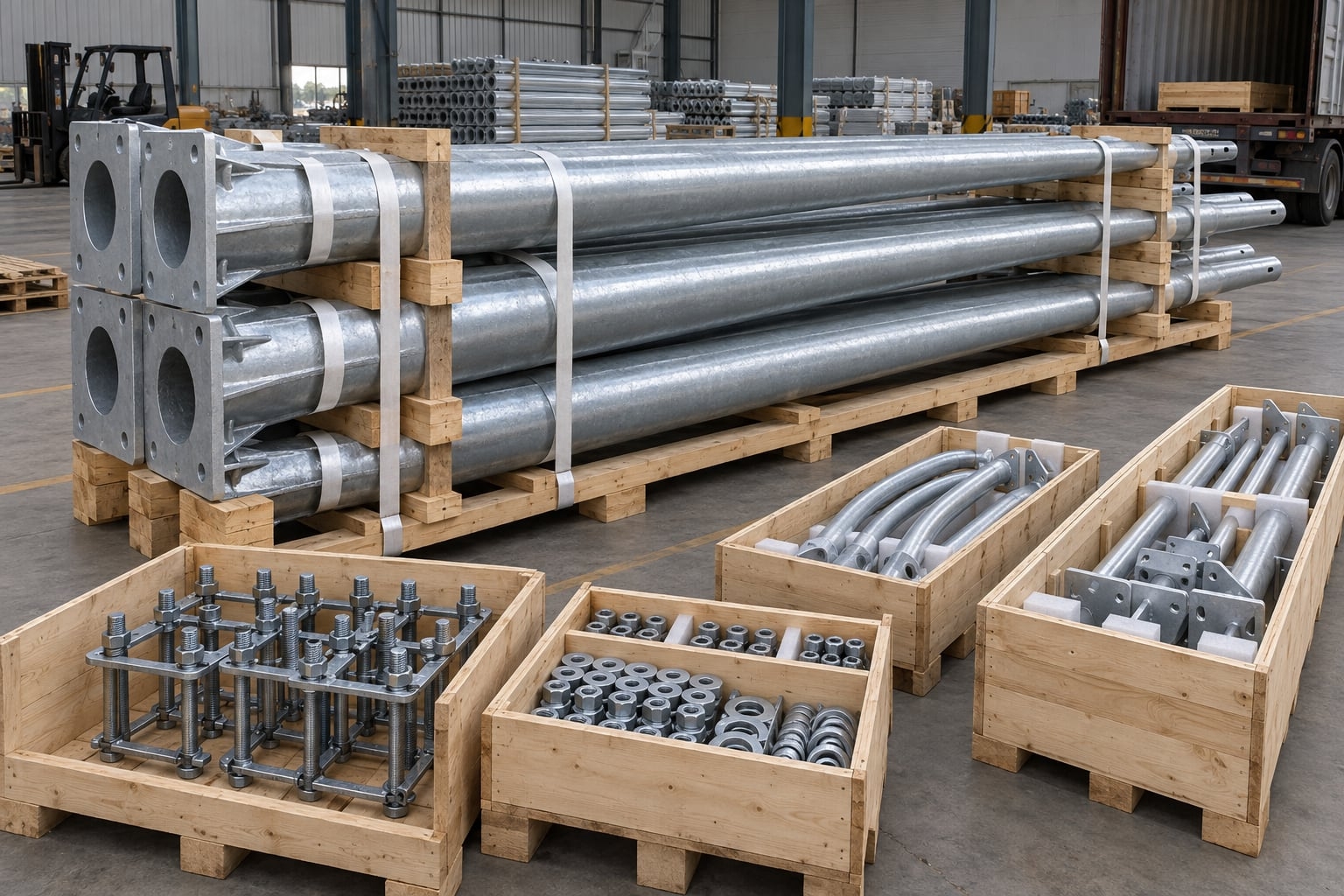
Keep long members and matched hardware identifiable in the load plan.
Confirm the internal loading envelope, door clearance, cargo mass distribution and safe unloading sequence. The longest member's theoretical length is not enough: flanges, arms, padding and lifting clearance also occupy space. Arrange pole marks so the destination can identify and remove parts in a practical sequence. Keep the heavy parts low and stable, subject to the approved load plan, and do not place loose hardware where it can strike a shaft in transit.
Use dunnage and restraints that prevent fore-aft sliding, side movement and rolling under expected transport conditions. The final restraint method should be specified by the competent logistics party; a generic photo cannot establish adequacy. Capture an overview before closure and closer views of protected contact points, marks, separate crates and final door-end arrangement. If customs inspection requires opening the package, provide a resealing and recount procedure.
This second table controls document flow from factory to site, rather than repeating the first table's physical packaging decisions.
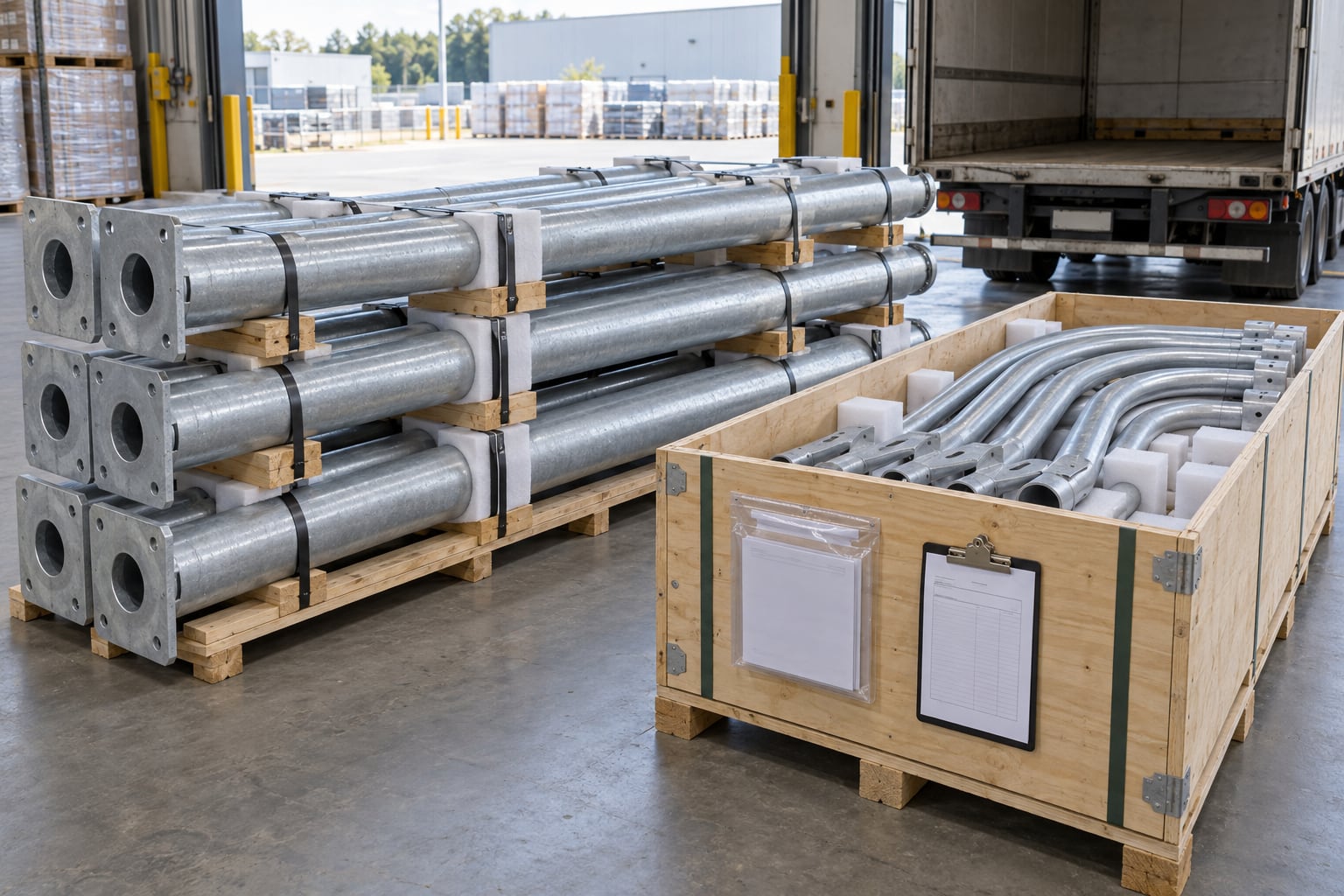
Bundle marks and a component-level packing list support receiving checks.
Use a line for each bundle and crate: ID, pole marks, component description, count, approximate dimensions and mass, drawing revision, and any handling orientation. Mark the outside of each bundle to match that line. If anchors, arms or doors travel separately, state where they are packed. The receiving team should not have to cut every wrap to locate one missing fastener.
The shipment documentation should distinguish supply scope from site tasks. A packed pole is not proof that the foundation matches its base interface. Link the packing list to the approved shop drawing and pass any interface notes to the installation team. The installation and erection checklist begins with receiving inspection and continues through lifting and handover.
Do not assume so. The packing method must control rubbing and impact for the specified finish and route; use approved separation and check contact points before release.
It depends on the assembly geometry, packing envelope and installation plan. A detached arm needs its own protection, matching mark and hardware count.
The responsible packing and transport team should design the specific load plan. This checklist does not provide a universal restraint calculation.
Use separated, labelled subpackages and a count by pole mark. The destination must be able to reconcile each assembly without inference.
No. Keep the signed packing list and shipping identifiers, then record condition and shortages when the cargo is opened at destination.
Contact Us
Get a custom lighting solution and quotation for your project. Outdoor lighting manufacturer in Yangzhou, ChinaAbout Jieyao LightingYangzhou Jieyao Lighting Equipment Co., Ltd. is an outdoor lighting manufacturer focused on solar street light systems and high mas... Do you have any questions or requests?
Email: jay@jieyaolighting.com

Click to Chat.
Im online now.